

Which Private Jet Is Right for Your Journey?
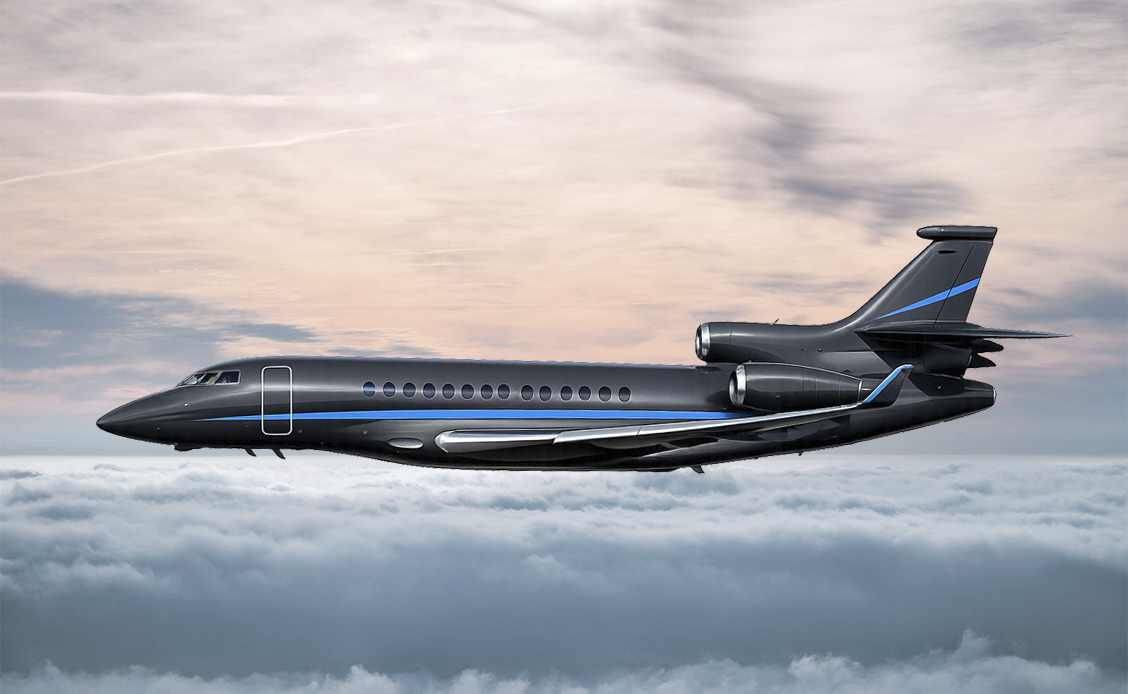
The Dassault Falcon 8X in Lohn Aviation’s fleet portfolio is an ultra-long-range private jet designed for comfortable nonstop intercontinental travel.
Lohn Aviation Fleet Guide This knowledge page complements the current Lohn Aviation Executive fleet overview. While the fleet page presents the aircraft currently operated by Lohn Aviation in a concise visual format, this guide explains which aircraft is best suited to each route, number of guests, baggage requirement and airport profile.
Private Jet Comparison: The Lohn Aviation Executive Fleet
The following table combines published manufacturer performance data with the cabin configurations shown in the current Lohn Aviation fleet overview. “Up to” refers to a value achieved under defined reference conditions, not a guaranteed range for a specific private charter flight. Berths or sleeping positions depend on the actual cabin configuration and do not constitute additional seats for take-off and landing.
| Aircraft | Class | Propulsion | Published maximum range | Published maximum speed | Lohn Aviation configuration | Particularly suited to |
|---|---|---|---|---|---|---|
| Dassault Falcon 8X | Ultra Long Range | Three-engine jet | 6,450 NM / 11,945 km | Mach 0.90 | 11 guests / up to 6 sleeping positions | Intercontinental travel, VVIP missions, family travel, spacious cabin |
| Dassault Falcon 7X | Long Range | Three-engine jet | 5,950 NM / 11,020 km | Mach 0.90 | 12 guests / up to 6 sleeping positions | International business and private travel |
| Gulfstream G550 | Ultra Long Range | Twin-engine jet | 6,750 NM / 12,501 km | Mach 0.885 | 14 guests / up to 7 sleeping positions | Very long nonstop routes, delegations, family offices |
| Pilatus PC-24 | Light Jet / Super Versatile Jet | Twin-engine jet | up to 2,040 NM / 3,778 km with 4 passengers | 440 KTAS / 815 km/h | 8 guests / up to 4 berths | Europe, short and suitable unpaved runways, bulky baggage |
| Cessna Citation XLS Gen2 | Midsize Jet | Twin-engine jet | 2,100 NM / 3,889 km | 441 KTAS / 817 km/h | 8 guests / up to 6 berths | European business travel, comfort-oriented groups |
| Embraer Phenom 300E | Light Jet | Twin-engine jet | 2,010 NM / 3,723 km with 5 occupants | 464 KTAS / 859 km/h | 8 guests / up to 4 berths | Fast European connections and smaller groups |
| Pilatus PC-12 NGX | Large turboprop | Single-engine turboprop | approximately 1,800 NM / 3,300 km, depending on the reference standard | 290 KTAS / 537 km/h | 8 guests / up to 4 berths | Regional airports, short runways, baggage, families |
| Embraer Phenom 100EV | Very Light Jet | Twin-engine jet | 1,178 NM / 2,182 km with 4 occupants | 406 KTAS / 752 km/h | 5 guests | Small groups, short- and medium-range jet travel |
| Daher TBM 960 | High-speed turboprop | Single-engine turboprop | 1,730 NM / 3,204 km at long-range cruise | 330 KTAS / 611 km/h | 4 guests | Very fast regional travel for a small group |
| Diamond DA62 | Piston touring aircraft | Twin-engine piston propulsion | up to 1,288 NM / 2,385 km, without reserves | 192 KTAS / 356 km/h maximum | 6 guests | Short regional routes, bespoke missions, training |
NM = nautical miles; KTAS = knots true airspeed; Mach = the ratio of airspeed to the local speed of sound. Manufacturers use different reference conditions. These figures are suitable for comparison, but not for operational flight planning.
How to Interpret Aircraft Range, Speed and Seating Capacity
Why published range is not a promise for every flight
A manufacturer’s range figure is established under precisely defined conditions: a specified number of occupants, a defined weight, standard temperature, a particular cruise speed and prescribed instrument-flight reserves. Conditions on an actual flight may differ considerably. Strong headwinds, high temperatures, icing, air traffic control rerouting, additional reserves, substantial baggage, a short runway or a more distant alternate airport can reduce the usable range. A tailwind may improve it.
Why speed alone does not determine journey time
Maximum cruise speed says little about total door-to-door travel time. A faster jet may require a larger airport, whereas the PC-24, PC-12 NGX, TBM 960 or DA62 may, under suitable conditions, use a smaller airfield closer to the destination. The full journey includes positioning, boarding, taxiing, the flight itself, immigration, baggage handling and the ground transfer. The most suitable aircraft minimises the entire travel chain, not merely the time spent at cruise altitude.
Why “eight guests” does not mean “eight guests plus unlimited baggage”
Seating capacity, range and baggage cannot be maximised independently of one another. More guests and more baggage increase payload. Depending on the aircraft, route, temperature and runway, this may reduce the fuel that can be carried or require a technical stop. To make a reliable selection, Lohn Aviation therefore needs not only the number of guests, but also the number, dimensions and type of baggage items.
Manufacturer configurations and the actual charter cabin
Manufacturers frequently publish several seating layouts. For each aircraft in its fleet portfolio, Lohn Aviation provides the relevant guest and berth capacities. Before booking, the aircraft, registration, cabin plan, sleeping configuration and baggage compartment are confirmed. These specific details govern the flight, not the manufacturer’s theoretical maximum seating configuration.
Long-Range Private Jets for Intercontinental Travel
The Falcon 8X, Falcon 7X and Gulfstream G550 are designed for long international missions. Depending on the layout, they offer pressurised stand-up cabins, separate living areas, substantial baggage capacity and sleeping arrangements. On long-range private jet flights, cabin quietness, layout, cabin pressure, sleeping positions, galley, lavatory, connectivity and crew planning become as important as range.
Dassault Falcon 8X
In brief: The Falcon 8X is a three-engine ultra-long-range business jet for intercontinental travel with demanding cabin and comfort requirements. Dassault publishes a range of up to 6,450 NM or 11,945 km at Mach 0.80 under defined conditions. Lohn Aviation offers a configuration for 11 guests and up to 6 sleeping positions.
- Manufacturer
- Dassault Aviation
- Aircraft class
- Ultra Long Range Jet
- Propulsion
- Three Pratt & Whitney Canada PW307D engines
- Published range
- 6,450 NM / 11,945 km
- Maximum operating Mach number
- Mach 0.90
- Lohn Aviation configuration
- 11 guests / up to 6 sleeping positions
- Key strength
- Spacious cabin, long nonstop routes, three engines and flexible airport capability within its class
The cabin can provide separate areas for working, dining, privacy and sleep. This makes the Falcon 8X particularly attractive to entrepreneurs, families, delegations and VVIP travellers who wish to use a long flight as productive or restorative travel time. Its extensive range can enable flights between Europe and North America, the Middle East, parts of Asia, Africa or the Indian Ocean without a scheduled fuel stop. Whether a specific city pair can be flown nonstop is calculated for the day of travel. When is it not automatically the best choice? On short European routes, a smaller aircraft may be more economical and able to land closer to the destination. The Falcon 8X is most compelling when its range, cabin zones, sleeping arrangements, baggage capacity or particular long-range capabilities provide a genuine advantage.
Dassault Falcon 7X
In brief: The Falcon 7X is a three-engine long-range business jet with a published range of up to 5,950 NM or 11,020 km. Lohn Aviation offers a cabin configuration for 12 guests and up to 6 sleeping positions.
- Manufacturer
- Dassault Aviation
- Aircraft class
- Long Range Jet
- Propulsion
- Three Pratt & Whitney Canada PW307A engines
- Published range
- 5,950 NM / 11,020 km
- Maximum operating Mach number
- Mach 0.90
- Lohn Aviation configuration
- 12 guests / up to 6 sleeping positions
- Key strength
- Intercontinental range and flexible long-range missions
The Falcon 7X is well suited to international business travel, private long-range journeys and complex multi-leg itineraries. Depending on its configuration, the cabin offers areas for working, dining and rest. Compared with the Falcon 8X, it is slightly shorter and has less range, yet remains a fully capable intercontinental jet. Falcon 7X or Falcon 8X? The 8X offers greater range and a longer cabin. The 7X may be the more appropriate choice when its range is sufficient and the specific cabin, availability or mission profile is a better fit. Sleeping arrangements and privacy depend not only on the aircraft model, but also on the actual floor plan.
Gulfstream G550
In brief: The Gulfstream G550 is a twin-engine ultra-long-range business jet. Gulfstream publishes a range of up to 6,750 NM or 12,501 km with eight passengers and four crew members. Lohn Aviation offers a configuration for 14 guests and up to 7 sleeping positions.
- Manufacturer
- Gulfstream Aerospace
- Aircraft class
- Ultra Long Range Jet
- Propulsion
- Two Rolls-Royce BR710 C4-11 engines
- Published range
- 6,750 NM / 12,501 km
- Maximum operating Mach number
- Mach 0.885
- Lohn Aviation configuration
- 14 guests / up to 7 sleeping positions
- Key strength
- Extensive range, high cruise speed and a cabin for larger groups
The G550 is particularly well suited to very long nonstop routes, international delegations, family office travel and missions requiring several cabin zones. Its nominal range is the greatest among the aircraft listed here. For an actual flight, however, the number of guests, baggage and operational reserves must be considered together; maximum range and maximum guest capacity do not automatically apply at the same time. G550 or Falcon 8X? Both serve ultra-long-range missions. The G550 offers the greater published maximum range, while the Falcon 8X provides a particularly long, flexible cabin and the airport performance associated with Dassault aircraft. The final selection should consider the cabin plan, sleeping arrangements, route, runway, positioning and availability.
Business Jets for Direct European Flights
The PC-24, Citation XLS Gen2 and Phenom 300E cover many typical journeys within Europe and neighbouring regions. They are faster than turboprops, require less airport infrastructure than large long-range jets and are well suited to business travel, weekend journeys, family travel and multi-sector day programmes. The three aircraft differ primarily in cabin space, runway flexibility, baggage access, speed and the relationship between range and payload.
Pilatus PC-24
In brief: The PC-24 is a twin-engine business jet with exceptional short-field and surface flexibility. Pilatus publishes a range of up to 2,040 NM or 3,778 km with four passengers and a maximum cruise speed of 440 KTAS or 815 km/h. Lohn Aviation offers a configuration for 8 guests and up to 4 berths.
- Manufacturer
- Pilatus Aircraft
- Aircraft class
- Light jet / “Super Versatile Jet”
- Propulsion
- Two Williams International FJ44 engines
- Published range
- up to 2,040 NM / 3,778 km with four passengers
- Maximum cruise speed
- 440 KTAS / 815 km/h
- Lohn Aviation configuration
- 8 guests / up to 4 berths
- Key strength
- Short and suitable unpaved runways, large cargo door and flexible cabin
The PC-24 combines jet speed with capabilities more commonly associated with versatile turboprops. It is designed to operate from short runways and, subject to the relevant approvals and operating conditions, unpaved surfaces such as grass, gravel, earth or snow. Its standard large cargo door simplifies the carriage of bulky baggage, sports equipment and larger items. These capabilities do not mean that every short or unpaved runway can be used. Length, load-bearing capacity, surface, braking action, obstacles, temperature, wind, weight, weather, airport approval and crew qualification must all be compatible. On many European missions, the PC-24 is particularly compelling when a smaller airport closer to the destination reduces ground-transfer time.
Cessna Citation XLS Gen2
In brief: The Citation XLS Gen2 is a twin-engine midsize business jet with a comparatively spacious cabin for its class. Textron Aviation publishes a range of up to 2,100 NM or 3,889 km and a maximum cruise speed of 441 KTAS or 817 km/h. Lohn Aviation offers a configuration for 8 guests and up to 6 berths.
- Manufacturer
- Textron Aviation / Cessna
- Official model designation
- Citation XLS Gen2
- Aircraft family
- Citation 560XL
- Propulsion
- Two Pratt & Whitney Canada PW545C engines
- Published range
- 2,100 NM / 3,889 km
- Maximum cruise speed
- 441 KTAS / 817 km/h
- Lohn Aviation configuration
- 8 guests / up to 6 berths
The XLS Gen2 suits travellers seeking greater cabin space on European routes without using a large long-range jet. Typical profiles include business travel with several guests, weekend and family journeys, and city pairs linking Germany, France, the United Kingdom, Italy, Spain, Austria and Switzerland. Important distinction between model names: The Citation XLS+ and Citation XLS Gen2 are different variants within the 560XL family. The expression “XLS+ Gen2” is occasionally used informally, but is not an unambiguous official model designation. The specific variant should be confirmed from the aircraft details and cabin plan before booking.
Embraer Phenom 300E
In brief: The Phenom 300E is a fast twin-engine light jet. Embraer publishes a range of up to 2,010 NM or 3,723 km with five occupants and a high-speed cruise of 464 KTAS or 859 km/h. Lohn Aviation offers a configuration for 8 guests and up to 4 berths.
- Manufacturer
- Embraer Executive Jets
- Aircraft class
- Light Jet
- Propulsion
- Two Pratt & Whitney Canada PW535E1 engines
- Published range
- 2,010 NM / 3,723 km with five occupants
- High-Speed Cruise
- 464 KTAS / 859 km/h
- Lohn Aviation configuration
- 8 guests / up to 4 berths
- Key strength
- High speed and strong range within the light-jet class
The Phenom 300E is well suited to fast business trips, city pairs and private short- to medium-range travel for smaller groups. Its external baggage compartment is generous for a light jet, although golf bags, skis, pushchairs and large hard-shell cases should still be measured and confirmed in advance. Phenom 300E or Citation XLS Gen2? As a light jet, the Phenom 300E is particularly fast and efficient. The Citation XLS Gen2 generally provides the more spacious feel of a midsize cabin. The number of guests is therefore not the only consideration; height, time on board, baggage and the desired freedom of movement are equally relevant.
Turboprops, Very Light Jet and Regional Aircraft
On short- and medium-range routes, a smaller aircraft can be the more precise solution. The PC-12 NGX, Phenom 100EV, TBM 960 and DA62 serve different profiles: a large cabin and cargo door, compact jet comfort, high turboprop speed or particularly efficient regional mobility.
Pilatus PC-12 NGX
In brief: The PC-12 NGX is a pressurised single-engine turboprop with a spacious cabin, cargo door and strong short-field capability. Depending on the data set and reference standard, Pilatus publishes a range of approximately 1,800 NM or 3,300 km and a maximum cruise speed of 290 KTAS or 537 km/h. Lohn Aviation offers a configuration for 8 guests and up to 4 berths.
- Manufacturer
- Pilatus Aircraft
- Aircraft class
- Large single-engine turboprop
- Propulsion
- One Pratt & Whitney Canada PT6E-67XP engine
- Published range
- approximately 1,800 NM / 3,300 km, depending on the reference standard
- Maximum cruise speed
- 290 KTAS / 537 km/h
- Lohn Aviation configuration
- 8 guests / up to 4 berths
- Key strength
- Short runways, suitable unpaved strips, large cargo door and flexible cabin
The PC-12 NGX is particularly valuable when a smaller airfield lies closer to the actual destination or when substantial or bulky baggage is to be carried. Depending on the specific payload, it can accommodate business travellers, families, sports equipment and extensive travel baggage. On routes within Europe, the time saved on the ground can exceed the speed advantage of a jet. What does single-engine turboprop mean? The PC-12 NGX has one turboprop engine and is certified for single-engine operation. The mission, route, weather, airport and operating procedures are planned in accordance with the applicable regulations. Any preference regarding propulsion or crew complement should be stated at the enquiry stage.
Embraer Phenom 100EV
In brief: The Phenom 100EV is a compact twin-engine very light jet for short- and medium-range travel. Embraer publishes a range of 1,178 NM or approximately 2,182 km with four occupants and a high-speed cruise of 406 KTAS or approximately 752 km/h. Lohn Aviation offers a configuration for 5 guests.
- Manufacturer
- Embraer Executive Jets
- Aircraft class
- Very Light Jet
- Propulsion
- Two Pratt & Whitney Canada PW617F1-E engines
- Published range
- 1,178 NM / 2,182 km with four occupants
- High-Speed Cruise
- 406 KTAS / approximately 752 km/h
- Lohn Aviation configuration
- 5 guests
- Key strength
- Jet speed for small groups on short- to medium-range routes
The Phenom 100EV suits small teams, couples and families seeking jet comfort and a fast point-to-point connection over manageable distances. Depending on the departure point and conditions on the day, examples may include routes within Germany or to the Benelux countries, France, northern Italy, Austria and Switzerland. Avoiding unit errors: For this model, the frequently quoted figure of 1,178 is expressed in nautical miles, not kilometres. Under manufacturer conditions, this converts to approximately 2,182 km. The distinction is essential for an accurate comparison.
Daher TBM 960
In brief: The TBM 960 is a very fast single-engine turboprop for small travel groups. Daher publishes a range of up to 1,730 NM or 3,204 km at a long-range cruise speed of 252 KTAS, and a maximum cruise speed of up to 330 KTAS or 611 km/h. Lohn Aviation offers a configuration for 4 guests.
- Manufacturer
- Daher Aircraft
- Aircraft class
- High-Performance Single-Engine Turboprop
- Propulsion
- One Pratt & Whitney Canada PT6E-66XT engine
- Published maximum range
- 1,730 NM / 3,204 km at 252 KTAS
- Maximum cruise speed
- 330 KTAS / 611 km/h
- Lohn Aviation configuration
- 4 guests
- Key strength
- High speed and efficiency for a small group
The TBM 960 is particularly appropriate when one to four guests wish to travel quickly between regional airports without requiring a large cabin. It is faster than many conventional turboprops, yet remains smaller than a PC-12 NGX. The published 3,204 km range is achieved at an economical long-range cruise setting; according to the manufacturer, range decreases at maximum cruise speed. TBM 960 or PC-12 NGX? The TBM 960 prioritises speed and efficiency for a small group. The PC-12 NGX offers a substantially larger cabin, greater seating and baggage flexibility, and a large cargo door. The PC-12 is often more suitable for bulky baggage, several guests or families; for a fast business trip for two, the TBM may hold the advantage.
Diamond DA62
In brief: The DA62 is a twin-engine piston touring aircraft with an unpressurised cabin for regional flights, smaller groups, training and specialised mission profiles. Diamond publishes a maximum range of up to 1,288 NM or 2,385 km with an auxiliary tank, at 50 per cent power and without reserves. Maximum speed is 192 KTAS or 356 km/h; published cruise speed at 85 per cent power is 180 KTAS or 333 km/h. Lohn Aviation offers a configuration for 6 guests.
- Manufacturer
- Diamond Aircraft Industries
- Aircraft class
- Twin-engine piston touring aircraft
- Propulsion
- Two Austro Engine AE330 engines
- Published maximum range
- 1,288 NM / 2,385 km, including auxiliary tank and without reserves
- Published cruise speed
- 180 KTAS / 333 km/h at 85 per cent power
- Lohn Aviation configuration
- 6 guests
- Key strength
- Efficient short regional routes and bespoke mission profiles
The DA62 is neither a private jet nor a turboprop. Its strengths lie in short regional connections, modest airport-infrastructure requirements and flexible mission profiles. Compared with the pressurised aircraft in the fleet, it flies lower and more slowly. This makes it attractive for short distances, but not the first choice for long routes or guests expecting a large stand-up cabin. According to the manufacturer, the theoretical maximum range includes no reserves and is therefore not directly comparable with the NBAA IFR ranges of business jets. Fuel reserves, weather, alternates, payload and flight time are planned separately for every actual mission.
Which Aircraft Suits Which Travel Profile?
Intercontinental business travel
Primary options to consider: Gulfstream G550, Falcon 8X and Falcon 7X. Relevant factors include nonstop capability, cabin zones, sleeping positions, connectivity, baggage, crew rest and the ability to remain productive after landing.
Private long-range or family travel
Primary options to consider: Falcon 8X, Gulfstream G550 and Falcon 7X. Families benefit from separate living areas, sleeping arrangements, more generous baggage capacity and journey planning that accounts for meals, children, pets and ground transfers.
Business appointment within Europe
Primary options to consider: Phenom 300E, Citation XLS Gen2 and PC-24; for a small group and short route, also the Phenom 100EV or TBM 960. The selection depends on whether speed, cabin height, a short ground transfer, baggage capacity or efficiency takes priority.
Travel to a regional airport or short runway
Primary options to consider: PC-12 NGX and PC-24; depending on runway, distance and group size, also the TBM 960 or DA62. Suitability cannot be inferred from the aircraft model alone. Runway length, surface, load-bearing capacity, elevation, obstacles, wind, temperature, moisture, snow, de-icing and take-off weight are decisive.
Weekend or city journey for a couple
Primary options to consider: Phenom 100EV, TBM 960, Phenom 300E or PC-12 NGX. The Phenom 100EV may suit light baggage and a fast journey by jet. The TBM is attractive when using a smaller destination airport; with more baggage or a pet, the PC-12 NGX may offer advantages.
Ski, golf or sporting journey with bulky baggage
Primary options to consider: PC-24 or PC-12 NGX; over greater distances, Falcon 8X, Falcon 7X or G550. Door dimensions and usable volume are decisive, not merely the published baggage-compartment volume. Equipment should be specified by length, width, height and weight.
Multi-city journey with several appointments
Primary options to consider: PC-24, Citation XLS Gen2, Phenom 300E or Falcon 7X for longer sectors. In addition to range, crew duty time, airport opening hours, slots, night-flight restrictions, icing risk and the aircraft’s position after the final sector all matter.
Efficient short regional travel
Primary options to consider: TBM 960, DA62, PC-12 NGX or Phenom 100EV. Over short distances, the fuel-efficiency advantage of a smaller aircraft can be significant. The best solution nevertheless depends on cabin expectations, weather, runway, flight time and the number of guests.
Direct Aircraft Comparisons: Similar Mission, Different Strengths
Falcon 8X vs. Falcon 7X vs. Gulfstream G550
All three are intercontinental business jets. At 6,750 NM, the G550 has the greatest published range, followed by the Falcon 8X at 6,450 NM and the Falcon 7X at 5,950 NM. Range alone does not determine the choice: the actual cabin, sleeping configuration, number of guests, baggage, airport suitability, aircraft position and availability are at least as important.
PC-24 vs. Citation XLS Gen2 vs. Phenom 300E
The PC-24 specialises in short-field operations, certain unpaved runways and bulky baggage. The Citation XLS Gen2 prioritises midsize-cabin comfort. The Phenom 300E combines high speed with light-jet efficiency. For a straightforward city-pair flight, the Phenom may be particularly suitable; for a short or unusual runway, the PC-24; and for greater cabin space, the XLS Gen2.
PC-12 NGX vs. TBM 960
Both are single-engine turboprops. The TBM 960 is faster and optimised for a small group. The PC-12 NGX offers a substantially larger cabin, greater seating and baggage flexibility, and a large cargo door. A fast business appointment for two often favours the TBM; a family with baggage or a flight to a distinctive destination may favour the PC-12.
Phenom 100EV vs. TBM 960
The Phenom 100EV is a twin-engine very light jet; the TBM 960 is a single-engine turboprop. The Phenom flies higher and offers the character of a jet, while the TBM can be highly efficient on regional routes and at smaller airports. Range, runway, weather, baggage, cabin preference and cost determine the choice.
Phenom 100EV vs. Diamond DA62
The Phenom 100EV is considerably faster, pressurised and designed for higher altitudes. The DA62 is a twin-engine piston aircraft for short regional missions. The Phenom holds the advantage for time savings and jet comfort; for a very short and efficient regional route, the DA62 may be the more sensible choice.
Jet vs. turboprop: which is better?
Neither concept is inherently better. Jets are generally faster over longer distances and at higher altitudes. Depending on the model, turboprops can be more efficient on short routes and offer excellent short-field performance. The right question is: which combination of flight time, ground time, runway, cabin, baggage and cost best suits the mission?
Knowledge Base: How Private Aircraft Selection and Flight Planning Work
1. The journey begins with the mission, not an aircraft model
A well-founded enquiry specifies the point of departure, destination, date, preferred times, flexibility, number of guests, baggage and any special requirements. These details define the mission profile. A preference for a particular aircraft can be considered, but it must suit the route and airports involved.
2. Door-to-door time is more meaningful than flight time alone
Private aviation saves time principally through direct connections, smaller terminals, flexible departure times and access to airports closer to the final destination. A turboprop may be slower in the air than a jet yet still reach the actual destination sooner by avoiding a lengthy ground transfer.
3. Runway length is only one part of the airport assessment
Other factors include runway width, surface, load-bearing capacity, gradient, contamination, braking action, airport elevation, temperature, wind, obstacles, available approach procedures, fire category, customs, immigration, fuel, handling, opening hours and night-flight restrictions. A list of “accessible airports” can therefore never replace an assessment for the specific day of travel.
4. Nonstop is not always the best solution
A refuelling stop may be necessary or advisable if headwinds, a high payload, a short runway or operational reserves limit nonstop range. In some cases, a smaller aircraft with a planned stop can provide access to an airport closer to the destination or offer better availability. The journey must be considered as a whole.
5. Baggage is planned by weight, volume and shape
A soft weekender bag can be stowed differently from a rigid suitcase. Golf bags, skis, bicycles, pushchairs, musical instruments, sample cases and pet carriers may determine the choice of aircraft. Photographs and dimensions assist flight operations. “Airline-style hand baggage” is not a reliable benchmark because baggage compartments vary considerably in shape between aircraft models.
6. Pets require a separate travel assessment
Private aviation often allows a dog or other pet to travel in the cabin. Immigration and animal-health regulations nevertheless continue to apply. The required information includes species, breed, weight, size, carrier, microchip, vaccination and document status. Certain countries require advance notification, health certificates or quarantine.
7. Sleeping positions are configured berths
“Six sleeping positions” does not mean six separate beds as in a hotel. In business jets, berths are typically created from fully or substantially lie-flat seats, facing seat groups, divans or prepared sleeping surfaces. The precise arrangement should be explained with reference to the cabin plan.
8. Crew and cabin service depend on the mission and aircraft
Large long-range jets operate with two pilots and, depending on the mission, additional cabin crew. Smaller aircraft with the relevant certification may technically be approved for a single pilot; the actual crew is nevertheless determined by the commercial operating framework, company policies and the mission. Catering, a flight attendant, turndown service and special requests are confirmed individually.
9. Weather affects comfort, range and airport selection
Wind affects flight time and fuel requirements. High temperatures reduce take-off performance. Fog or low cloud may render an airport without an appropriate precision approach unusable. Snow, water or ice changes the available braking action. For demanding airports, a realistic alternative plan is an integral part of sound journey planning.
10. Slots, opening hours and permits may matter more than range
Airports with high demand allocate time windows for take-off and landing. Night-flight restrictions, parking positions, customs hours, diplomatic clearances, traffic rights and overflight permits may affect the route. Operational coordination is therefore an essential part of international or short-notice missions.
11. Ownership, management, operation and brokerage are different roles
An aircraft may be owned by a private individual, managed by an aircraft-management company, operated under an operator’s Air Operator Certificate or arranged through a partner. Before a contract is concluded, the specific aircraft offered, the company operating the flight and the applicable conditions of carriage should be clear. “Fleet portfolio” describes the aircraft models available or under management; it does not automatically imply a uniform ownership structure. The Lohn Aviation Group page explains the corporate structure and the Executive Aviation, Charter and Cargo divisions. The actual operator and specific aircraft are named and confirmed separately for every flight.
12. Safety cannot be inferred from aircraft age or number of engines alone
Relevant factors include certification, the operator’s certificate, maintenance, crew qualifications, training, safety management, weather decisions, operating procedures and regulatory oversight. A young aircraft is no substitute for robust processes; nor can a single-engine aircraft be assessed solely by its number of engines. Transparent information about the actual operator and aircraft is valuable to clients.
13. Emissions depend heavily on aircraft size, occupancy and route
A smaller aircraft appropriately matched to the mission will generally use less fuel than a large long-range jet on the same short route. The actual climate impact depends on the aircraft, engines, route, altitude, occupancy, positioning flights and fuel. Depending on availability, supply chain and blend, Sustainable Aviation Fuel can reduce life-cycle emissions, but it does not make a flight emission-free.
14. A reliable quotation requires specific travel details
- Departure and destination airports, or the journey’s start and destination addresses
- Date, preferred time and scheduling flexibility
- Number of adults, children and, where applicable, infants
- Number, dimensions and weight of baggage items
- Sports equipment, special baggage or goods
- Pets, including species, size and weight
- Cabin preferences, sleeping requirements, catering and connectivity
- Return flight, additional sectors and waiting times
- Nationalities, where relevant to immigration and permits
Private Aviation Glossary
- AOC – Air Operator Certificate
- An Air Operator Certificate confirms that a company may conduct commercial air transport subject to the applicable requirements. The actual operator should be named in the quotation.
- Alternate airport
- An airport included in the flight plan as an alternative if the destination airport cannot be used. The distance to the alternate affects the amount of fuel required.
- Block time
- The time from the release of the parking brake at departure until the parking brake is set at the destination. It includes taxiing and flight and is therefore longer than flight time alone.
- Cabin altitude
- The air pressure inside a pressurised cabin expressed as an equivalent altitude. A lower cabin altitude can improve comfort on long flights.
- Empty Leg
- A positioning flight without a primary client booking that may be offered at a reduced price. Its route and timing are usually determined by the underlying flight and are less flexible.
- Ferry or positioning flight
- A flight that moves an aircraft to the departure point of a client’s journey or to its next assignment after the client’s flight. Positioning affects availability and price.
- IFR
- Instrument Flight Rules. They govern flights conducted under instrument procedures and require defined planning, equipment and reserves.
- KTAS
- Knots True Airspeed. One knot equals one nautical mile per hour, or 1.852 km/h. KTAS describes true speed relative to the surrounding air, rather than speed over the ground.
- Mach
- The ratio of an aircraft’s speed to the local speed of sound. Mach 0.80 equals 80 per cent of the local speed of sound; the corresponding km/h value varies with temperature and altitude.
- Nautical mile
- A unit of distance used in aviation and maritime navigation. One nautical mile, abbreviated NM, equals exactly 1.852 kilometres.
- NBAA IFR range
- A comparative value based on defined assumptions regarding passenger load, flight profile and IFR reserves. NBAA IFR figures from different manufacturers may nevertheless use different assumptions in detail.
- Nonstop
- A flight without a scheduled intermediate landing. “Direct flight” is often used synonymously in everyday language but may include an intermediate stop in other transport contexts.
- Payload
- The weight of guests, baggage and other cargo. A higher payload may limit the fuel that can be carried and therefore reduce range.
- Short Field
- Operation from a comparatively short runway. An individual performance calculation is always required.
- Slot
- An allocated time window for take-off or landing at a coordinated airport. A slot may constrain the preferred departure time.
- Turboprop
- A gas turbine that primarily drives a propeller. Turboprops combine turbine technology with propeller efficiency and are particularly well suited to short- and medium-range routes.
- Very Light Jet
- A compact class of small business jets, typically designed for a small number of guests and short- to medium-range routes. The Phenom 100EV belongs to this category.
- Wet Lease / ACMI
- The provision of an aircraft including Aircraft, Crew, Maintenance and Insurance. The term is primarily relevant to airline and large-scale charter operations and is not equivalent to a single private jet booking.
Frequently Asked Questions About the Lohn Aviation Fleet and Aircraft Selection
Which aircraft are included in the current Lohn Aviation Executive fleet portfolio?
The authoritative source for the current portfolio is the Lohn Aviation Executive fleet overview. This fleet guide documents and explains the Dassault Falcon 8X, Dassault Falcon 7X, Gulfstream G550, Pilatus PC-24, Cessna Citation XLS Gen2, Embraer Phenom 300E, Pilatus PC-12 NGX, Embraer Phenom 100EV, Daher TBM 960 and Diamond DA62. Availability and cabin configuration are confirmed for each flight.
Which aircraft has the greatest published range?
Among the models listed here, the Gulfstream G550 has the greatest published manufacturer range at up to 6,750 NM or 12,501 km. It is followed by the Falcon 8X at 6,450 NM and the Falcon 7X at 5,950 NM. These figures apply under defined manufacturer conditions.
Which aircraft are suited to intercontinental nonstop flights?
Principally the Falcon 8X, Falcon 7X and Gulfstream G550. Whether a specific route can be flown nonstop depends on distance, wind, weather, guests, baggage, reserves, airports and performance on the day.
Which aircraft is suitable for short or unpaved runways?
The PC-24 and PC-12 NGX are particularly versatile. The PC-24 is certified for certain unpaved surfaces, while the PC-12 family can also use suitable grass, gravel or snow-covered runways. Every runway is assessed individually for length, condition, load-bearing capacity, obstacles, weather and aircraft loading.
Can every aircraft described as short-field capable land at Courchevel, London City or La Môle?
No. Each of these airports has its own procedures, approvals, gradients, runway conditions, operating hours and crew requirements. The aircraft model, specific aircraft, crew, weather and loading must all be approved and suitable for the particular flight.
What is the difference between the PC-24 and the PC-12 NGX?
The PC-24 is a twin-engine jet and considerably faster. The PC-12 NGX is a single-engine turboprop and efficient on many short- to medium-range regional routes. Both feature large cargo doors and strong short-field capabilities. The right choice depends on distance, runway, schedule, baggage and cabin requirements.
What is the difference between the Phenom 300E and the Phenom 100EV?
The Phenom 300E is larger, faster and offers greater range. The Phenom 100EV is a compact Very Light Jet for smaller groups travelling on short- to medium-range routes. Lohn Aviation specifies configurations for eight and five guests respectively.
How far can the Phenom 100EV fly?
Embraer publishes a range of up to 1,178 NM, equivalent to approximately 2,182 km, with four occupants and defined reserves. The figure 1,178 denotes nautical miles, not kilometres.
Is the Citation XLS Gen2 the same aircraft as the Citation XLS+?
No. The Citation XLS+ and Citation XLS Gen2 are different variants of the Citation 560XL family. The official name of the newer model is Cessna Citation XLS Gen2. The specific variant should be confirmed when booking.
Are manufacturer range figures guaranteed nonstop ranges?
No. Manufacturer ranges are comparative figures under defined conditions. Payload, baggage, headwinds, temperature, de-icing, routing, alternate airports, reserves and runway conditions all affect the range that can be planned in practice.
Is the largest private jet automatically the best choice?
No. The best aircraft is the one that brings route, guests, baggage, airport, schedule, comfort and cost into balance. By using a regional airport closer to the final destination, a smaller aircraft may provide the shorter overall journey.
Which aircraft is particularly suitable for families?
That depends on the route, family size and baggage. On regional routes, the PC-12 NGX is often attractive because of its cabin and cargo door. For travel within Europe, the PC-24 or Citation XLS Gen2 may be suitable. On long-range journeys, the Falcon 8X, Falcon 7X and G550 offer more space and sleeping options.
Which aircraft makes sense for two to four business travellers?
For short- to medium-range routes, the TBM 960, Phenom 100EV, Phenom 300E or PC-12 NGX may be considered. The best choice depends on the runway, baggage, preferred speed, cabin size and distance.
Can I take golf bags, skis or bicycles?
Often yes, subject to advance assessment. The number, length, width, height and weight of the items should be specified. The PC-24 and PC-12 NGX have large cargo doors and are often advantageous for bulky baggage.
Can I travel with a pet on a private jet?
Subject to prior arrangement, pets can often travel in the cabin. The species, breed, size, weight, carrier, route and documents are required at an early stage. Immigration, vaccination and quarantine rules continue to apply in full.
What does “sleeping position” mean on a private jet?
Depending on the cabin, sleeping positions are created from convertible seat groups, fully or substantially lie-flat seats, divans or prepared sleeping surfaces. They are not necessarily separate beds. The specific cabin plan is decisive.
Which is safer: a jet or a turboprop?
A sound safety assessment cannot be based on the type of propulsion alone. Certification, maintenance, crew training, operator, weather decisions, procedures and oversight are decisive. The actual operator and aircraft should be stated transparently for the specific flight.
Why can planned range differ between winter and summer?
Wind patterns, temperature, icing conditions, de-icing, runway contamination and the selection of alternate airports change fuel requirements and performance. In summer, high temperatures at elevated airports or on short runways may limit take-off performance.
How quickly can a private flight be arranged?
That depends on aircraft and crew availability, positioning, slots, airport opening hours, handling, weather and permits. A straightforward European flight can often be arranged more quickly than a complex international mission.
Can I book a specific aircraft model on a binding basis?
Yes, provided the specific aircraft is available, suitable for the mission and confirmed contractually. A substitution provision may apply in the event of technical or operational changes. The quotation and conditions of carriage should clearly describe the model, variant and any possible substitution.
What is the difference between an operator and a broker?
An operator is responsible for the operation of an aircraft within the applicable operating framework. For commercial air transport, the operating AOC holder is the legally responsible air carrier. Lohn Aviation Executive operates 23 aircraft; ownership, aircraft management and the AOC assignment for a specific mission must be considered separately. A broker arranges flight services without necessarily operating the flight offered.
How is the price of a private flight calculated?
Important factors include aircraft type, flight and block time, positioning, crew, airport and handling charges, slots, de-icing, parking time, overnight stays, permits, catering and taxes. A low hourly rate does not automatically result in the lowest overall quotation.
Can Sustainable Aviation Fuel be used?
Many modern business aircraft can use approved SAF blends. Whether SAF is physically available for a specific flight or attributed through a book-and-claim model depends on the airport, supply chain and provider. SAF can reduce life-cycle emissions, but it does not make a flight emission-free.
Data Status, Sources and Editorial Methodology
Data status: 10 July 2026. The Executive fleet portfolio and Lohn Aviation cabin configurations were cross-checked against the published current fleet overview. Technical reference values are drawn primarily from manufacturer documentation. Where manufacturers apply different assumptions regarding payload, reserves or speed, this is stated in the text. This page should be reviewed at least quarterly and whenever an aircraft joins or leaves the fleet or its configuration changes. This page provides an accessible basis for comparison. It does not replace the flight manual, a performance calculation, quotation, contract of carriage, safety assessment or operational approval. The specific aircraft, actual cabin, flight planning by the operating carrier and conditions on the day of travel are always decisive.
Primary sources
- Lohn Aviation: current Executive fleet overview
- Lohn Aviation Group: corporate structure and business divisions
- Dassault Aviation: Falcon 8X
- Dassault Aviation: Falcon Family
- General Dynamics / Gulfstream: G550 performance
- Pilatus Aircraft: PC-24
- Textron Aviation: Citation XLS Gen2 performance and certification
- Embraer: Phenom 300E
- Embraer: Phenom 100EV performance reference
- Pilatus Aircraft: PC-12 NGX
- Daher Aircraft: TBM 960
- Diamond Aircraft: DA62 technical specifications
Select the Right Aircraft for Your Journey
Send us your point of departure, destination, date, preferred times, number of guests and baggage details. Lohn Aviation will assess range, cabin, airports, runways, crew, weather requirements and availability, then recommend a reliable solution for the entire journey. Request a flight