
The Most Expensive Private Jets in 2026: Purchase Prices, Ownership Costs and Value for the Owner
A private jet at the upper end of the market can cost approximately USD 85 million before the economics of operating it are considered. For a prospective owner, that purchase price is only the starting point. What matters is which journeys the aircraft enables, how reliably it is available and the total expenditure over the intended ownership period. A larger cabin and additional range can create substantial value. They also involve capital commitment, a demanding operating organisation and long-term obligations.
At Lohn Aviation, we approach these decisions through our daily work in flight planning, owner advisory and aircraft management. The assessment starts with the owner’s actual requirements and extends to the eventual sale. This article examines five particularly expensive business jets and explains the operational and financial considerations that matter in private jet ownership.
Assessment dated 13 October 2026. Confidential acquisition terms and operating data from individual mandates are not disclosed.
Which private jets sit at the top end of the market?
Particularly expensive purpose-built business jets include the Bombardier Global 8000, Gulfstream G700, Gulfstream G800, Dassault Falcon 8X and Gulfstream G600. The price indications below use the “BCA Equipped Price” figures in the Business & Commercial Aviation Purchase Planning Handbook, Q1 2026. They are benchmarks for equipped new aircraft, rather than binding manufacturer quotations or disclosed prices paid by our clients.
This selection is confined to conventional business jets. Aircraft based on large commercial airliner platforms form a separate category, in which the airframe, bespoke cabin completion and operation need to be assessed individually. Rankings that combine these concepts with purpose-built business aircraft offer only limited comparability.
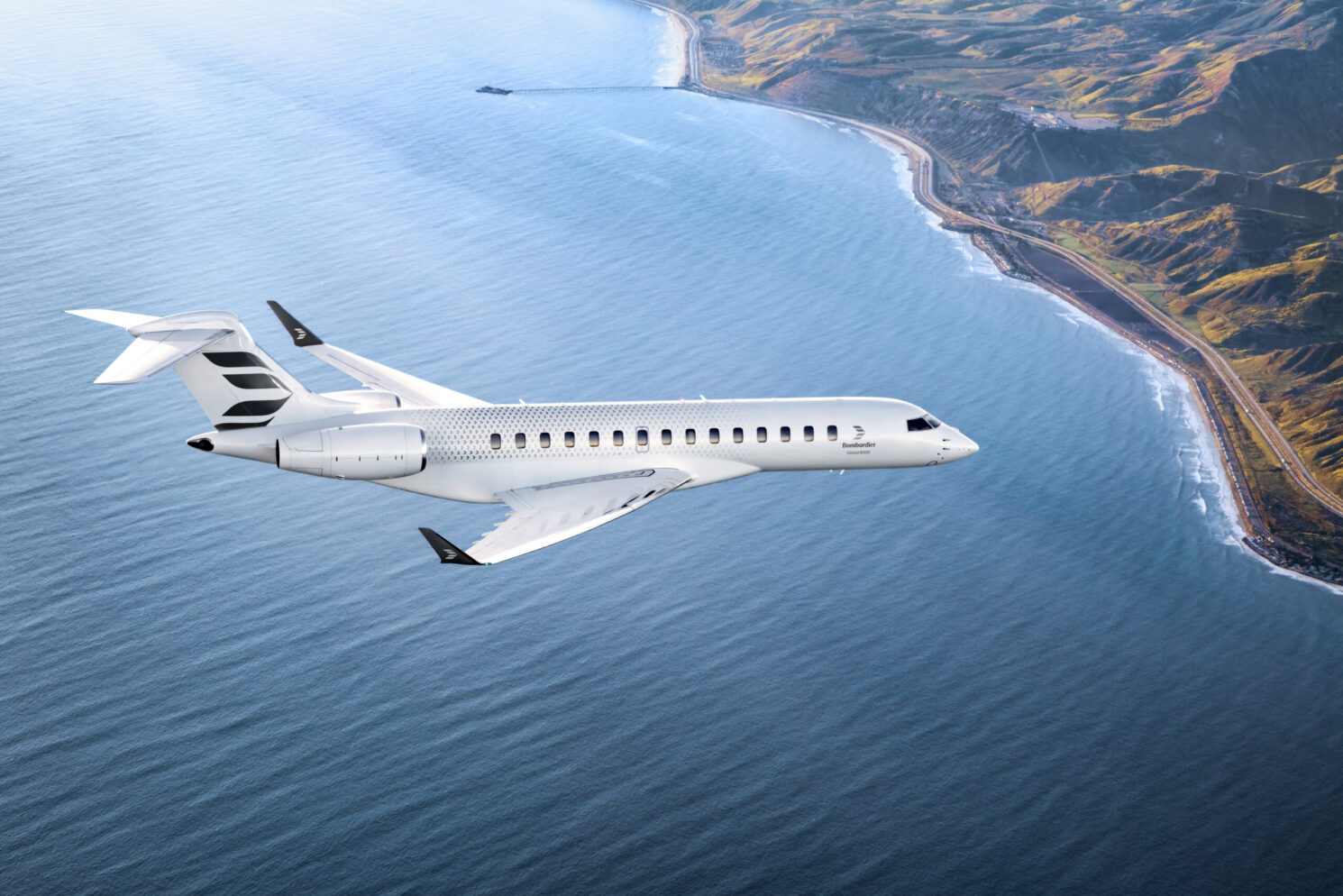
Bombardier Global 8000: approximately USD 85 million
The price benchmark for the Global 8000 is USD 85 million. Bombardier specifies a range of up to 8,000 nautical miles and a maximum operating speed of Mach 0.95. This combination can be relevant to owners whose regular journeys require exceptionally long nonstop sectors. Bombardier’s Global 8000 overview describes the aircraft and cabin concept.
The acquisition assessment must establish how frequently those capabilities will be used. Exceptional maximum performance delivers economic value when it serves the actual mission profile.
Gulfstream G700: approximately USD 84.9 million
The G700 has a price benchmark of USD 84.9 million. Gulfstream publishes a maximum range of 7,750 nautical miles at Mach 0.85 and describes a cabin offering up to five living areas. Further information appears in the official G700 overview.
Cabin organisation matters when passengers need to work, dine and sleep privately during the same journey. The benchmark price difference from the Global 8000 is small; equipment choices and contractual terms can change the actual comparison.
Gulfstream G800: approximately USD 80.4 million
The G800 is represented by a price benchmark of USD 80.4 million. Gulfstream specifies a range of up to 8,200 nautical miles at Mach 0.85 and up to four living areas. These characteristics are explained in the manufacturer’s G800 overview.
Additional range is particularly valuable when it avoids a fuel stop on frequently flown routes or creates greater operational flexibility. Its importance must therefore be assessed against specific journeys.
Dassault Falcon 8X: approximately USD 69.7 million
The Falcon 8X has a price benchmark of USD 69.7 million. Dassault publishes a range of 6,450 nautical miles and highlights its shorter-runway performance. The three-engine layout and principal specifications are described in Dassault’s Falcon 8X overview.
The Falcon 8X is an important candidate where access to the owner’s preferred airports carries substantial weight alongside long-range capability. Whether that creates an advantage requires assessment of each relevant mission.
Gulfstream G600: approximately USD 63.5 million
The price benchmark for the G600 is USD 63.5 million. Gulfstream specifies a maximum range of 6,600 nautical miles at Mach 0.85. Cabin options and performance information are available in the official G600 overview.
The G600 can be particularly relevant where the actual route network does not require the additional range of larger models. A lower acquisition price becomes meaningful when considered alongside operating expenditure, availability and eventual resale.
Why do these aircraft cost so much?
Much of the engineering investment supports capabilities that are invisible in cabin photographs. Long range requires a coordinated combination of aerodynamics, structure, engines, fuel capacity and systems. Development, certification, manufacturing and long-term product support add to that investment. Cabin furnishings and equipment must also meet weight limits and safety requirements while withstanding the demands of flight operations.
The actual purchase price is further influenced by equipment choices and the scope of the contract. Connectivity, cabin layout, materials and additional systems can create differences between two aircraft of the same model. During aircraft acquisition, it is therefore essential to establish what is included, which options attract additional charges and what obligations follow delivery. A published price cannot replace that review.
Published range is a conditional performance figure
Published range is a technical comparison under defined assumptions. It must be read together with operating speed, payload and reserves. Gulfstream, for example, explains that actual range is affected by air traffic control routing, weather, equipment and other factors. The relevant assumptions are set out in its official fleet overview.
Our operational assessment therefore considers specific city pairs with the intended passengers, luggage and travel arrangements. A route that appears theoretically achievable on a map is not necessarily available nonstop under every condition. Maximum advertised seating capacity should likewise not be equated with maximum range. Aircraft selection requires payload and fuel requirements to be considered together.
This is an essential part of our aircraft acquisition advisory work: regular journeys carry a different weight from occasional exceptions. Chartering for an infrequent long-haul requirement may make more financial sense than acquiring an aircraft with capabilities that are rarely needed during the rest of the year.
Falcon 8X or Gulfstream G700: which differences matter to an owner?
A comparison between the Falcon 8X and G700 needs to extend beyond purchase price and range. On long journeys, cabin organisation determines whether several passengers can work, dine and sleep at the same time. Other mission profiles place greater emphasis on preferred airports, ground arrangements and total journey time. For those requirements, the Falcon 8X deserves consideration in its own right, rather than simply as a less expensive alternative to a larger aircraft.
Our operational perspective considers the complete journey from the point of departure to the actual destination. A suitable arrival airport may avoid a lengthy road transfer. Whether it can be used depends on factors including aircraft loading, weather, runway conditions, obstacles and applicable operating requirements. A model’s suitability cannot be established from a single published take-off or landing distance. That assessment belongs within an aircraft management approach that connects aircraft selection with everyday operations.
A larger cabin also has different value for different owners. The relevant considerations are how many people regularly travel, how they spend their time on board and which facilities they actually need. Those requirements determine the appropriate solution.
What does it really cost to own an USD 85 million private jet?
Total ownership cost comprises the change in aircraft value over the ownership period, recurring operations, financing or committed capital, and acquisition and disposal costs. A purchase price of USD 85 million therefore describes neither annual expenditure nor a complete cost per flight hour. It is equally important to distinguish expenses incurred regardless of utilisation from those generated by individual flights.
Broadly recurring expenditure includes crew, training, insurance, hangarage, management and various technical or administrative services. Utilisation-related expenditure includes fuel, programme contributions linked to flight hours or cycles, and numerous flight-specific charges. Maintenance can have both calendar-driven and utilisation-driven elements. A meaningful budget needs to define these categories clearly and avoid double counting.
Within aircraft management, we also consider when expenditure occurs. A major maintenance bill can materially affect cash flow in a particular year even when the long-term average budget is appropriate. Technical downtime may also require replacement charter. The financial assessment therefore needs to address how the owner’s mobility will be maintained during periods of reduced availability.
Capital commitment and changes in value can outweigh operating expenditure
A purely illustrative calculation demonstrates the scale involved. Applying an assumed alternative annual return of 3 per cent to USD 85 million of committed capital produces an opportunity-cost figure of USD 2.55 million per year. This is neither a forecast nor necessarily a cash expense; it is an assumption used to assess the capital allocation. Where financing is used, the calculation must consistently distinguish debt interest from the equity actually committed.
Similarly, a 10 per cent reduction in value relative to that purchase price would represent USD 8.5 million. This is also only a calculation example, not an expected depreciation rate for a particular model or period. It demonstrates why eventual resale has significant influence on overall ownership economics. An aircraft financing and leasing assessment should therefore be connected to the intended holding period and several disposal scenarios.
When does buying make sense, and when should charter or leasing be considered?
Ownership can make sense where a reasonably stable travel profile, demanding availability requirements and a clear preference for a dedicated cabin and familiar crew come together. Its value can also lie in short-notice scheduling, continuity and control. Those benefits need to justify the recurring expenditure and financial exposure. They do not establish a universal annual flight-hour threshold at which every private jet purchase becomes worthwhile.
Private jet charter offers flexibility, particularly where routes and travelling groups vary considerably. A different aircraft can be selected for a short journey than for an intercontinental flight. That adaptability has financial significance, although availability, positioning and the terms of each quotation must also be considered.
Aircraft leasing can provide another option. The term, utilisation limits, maintenance obligations, return conditions and allocation of risk require careful review. Leasing does not automatically remove the financial obligations associated with aircraft operation. The specific arrangement determines which risks remain with the owner, lessor or operator.
Why additional charter hours do not automatically create additional value
An owned aircraft can be offered for charter to contribute towards recurring expenditure. The meaningful figure is the contribution remaining after incremental costs. Positioning flights, fuel, crew expenditure, maintenance exposure and additional flight cycles all need to be considered. Charter scheduling also affects availability for the owner.
An individual aircraft management strategy must therefore define the purpose of additional utilisation. An owner with a short investment horizon may have different priorities from someone intending to operate the aircraft for many years. Moderate utilisation may fit a disposal strategy, but it does not guarantee residual value. Maximum activity and financially appropriate utilisation are different objectives.
What should be established before an aircraft purchase?
A sound decision starts with a documented travel profile: regular routes, seasonal variations, passenger numbers, luggage and preferred airports. Cabin requirements, range and operational capability must then be matched to that profile. The financial assessment needs a multi-year budget, a realistic crew arrangement and a clear plan for technical downtime.
The intended ownership period and eventual disposal should also be considered early. Potential future buyers, maintenance events arising during ownership and the continuity of technical records are relevant questions. These connections bring together private jet ownership, acquisition advice and operation. Price comparison is one element of the decision; its quality depends on the complete ownership plan.
Transparency and confidentiality
The operational and financial analysis in this article reflects Lohn Aviation’s advisory perspective. Confidential client terms, cost accounts and mission data remain unpublished. The purchase-price benchmarks come from the publicly available BCA Purchase Planning Handbook, Q1 2026; the linked manufacturer pages explain the aircraft and performance figures rather than providing binding purchase quotations. Calculation examples are expressly illustrative assumptions. A specific decision requires current proposals and an individual assessment of utilisation, base, operating organisation, capital structure and intended ownership period.
The substance and factual content of this article come from the flying experience of our crew. AI assistance was used in drafting and structuring the text. It was reviewed and approved by our editorial team before publication.